
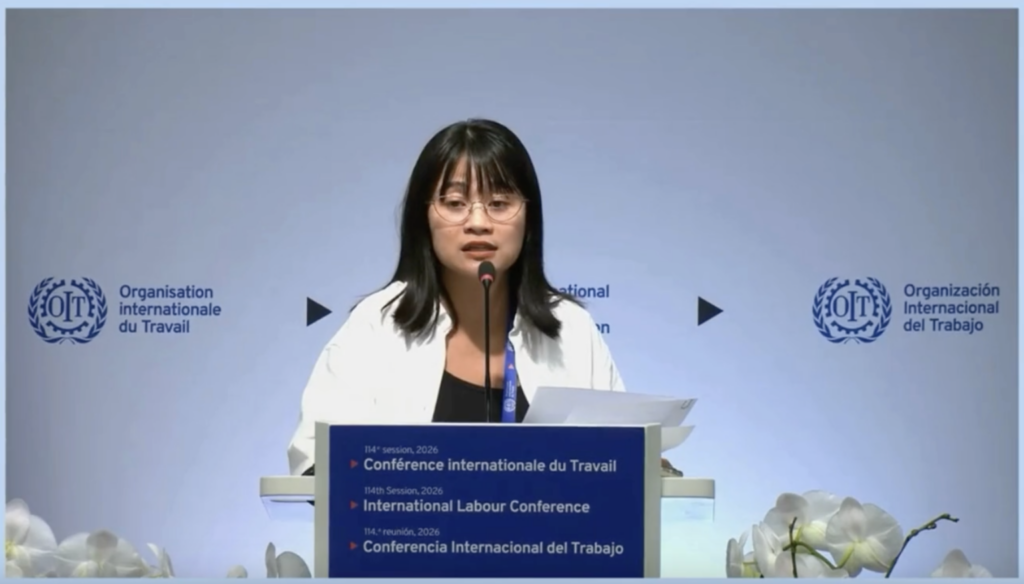
Joanne Cesario, Asia Pacific Forum on Women, Law, and Development
International Labour Conference 2026
Distinguished delegates, women workers of the world,
Today, we speak from a region burdened by war, crisis, and deepening exploitation. Across Asia and the Pacific, women workers bear the heaviest costs of an economic order built on violence and inequality.
Wars and geopolitical conflicts have triggered oil price shocks, inflation, food crisis, and mass displacement. Governments answer this crisis not with stronger regulation, social protection, public services, and living wages, but with corporate profiteering, privatization, and rising military spending. While corporations continue to accumulate wealth, working people, especially women, are forced to shoulder the burden of a crisis we did not create.
In Asia and the Pacific, women are now concentrated in the most precarious sectors of labor: informal work, agriculture, migrant labor, domestic work, garment production, and platform-based employment. Millions labor without secure wages, contracts, healthcare, or social protection. More than 60 percent of workers in our region remain trapped in informal and unprotected employment, leaving women highly vulnerable to layoffs, debt, hunger, and economic shocks.
Women produce food, sustain communities, and reproduce the labor force, yet we continue to face lower wages and insecure employment. Women’s labor force participation in Asia and the Pacific is around 51 per cent, compared with 71 per cent for men, and women earn on average 20 percent less than men for work of equal value.
The impacts of war and crisis intensify these inequalities.
When governments prioritize military spending and debt repayment over social services, women absorb the consequences. Cuts to healthcare, education, and welfare programs push care responsibilities back onto women inside the household. Rising food prices mean mothers skip meals so their children can eat. Climate disasters, price shocks, and forced migration push women deeper into poverty and exploitation.
For migrant women workers, crisis means heightened vulnerability to trafficking, abuse, and labor violations. For Indigenous and peasant women, land liberalization and corporate plunder destroy livelihoods and displace entire communities. For women in digital platform work, algorithmic surveillance, unstable income, and unclear employment status have become new forms of exploitation disguised as “flexibility.”
And when women workers organize to resist these conditions, we are attacked.
Across the region, women trade unionists, labor organizers, and labor rights defenders face intimidation, criminalization, imprisonment, enforced disappearances, and killings. Civic spaces continue to shrink under authoritarian governments that treat dissent as a threat. Women workers who assert their right to organize and collectively bargain are met with repression instead of justice.
These realities expose the true nature of an economic system that claims to promote development while deepening inequality, exploitation, and militarism. We therefore assert that genuine development cannot exist without labor rights, economic sovereignty, gender justice, and peace.
We also assert that women workers are not merely victims of crisis — we are at the forefront of resistance and social transformation. Our labor sustains society, and our collective resistance has the power to transform it.
Across Asia and the Pacific, we are already organizing. Women workers and migrant women are demanding labor rights and protection. Alongside us, rural women are building food sovereignty while Indigenous women defend ancestral lands and communities against displacement and plunder.
To the women workers across the globe: Let us unite against war and exploitation. Let us demand our rights to living wages, job security, organizing, collective bargaining, and strike. Let us defend the rights and dignity of all workers, especially women who stand at the frontlines of crisis and resistance. Let us organize to challenge economic systems built on violence and inequality, and to build a future where rights, dignity, and care are valued above profit.