
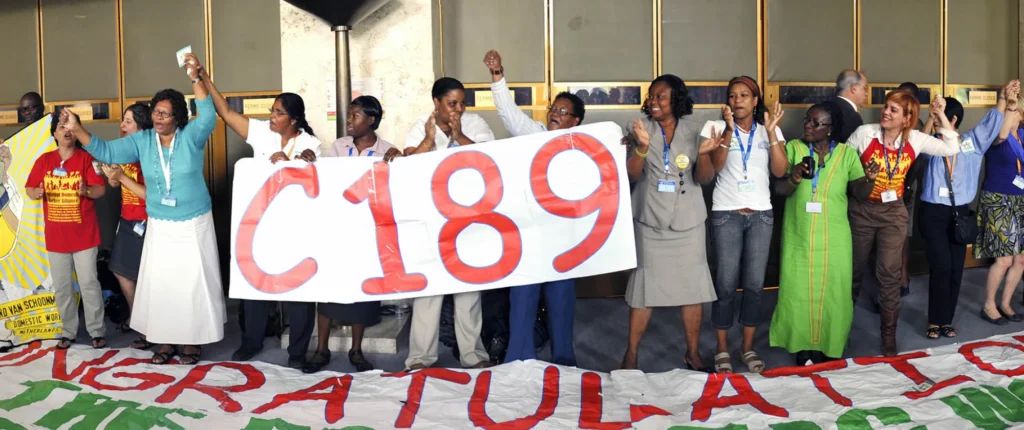
Over the past 15 years, the Domestic Workers Convention, 2011 (No. 189) has helped drive reforms benefiting millions of domestic workers through improved labour protections, access to social security and recognition of their contribution to economies and societies. The timeline below looks back at key milestones that have shaped progress on rights and protections for domestic workers worldwide.
16 Jumi 2011
After years of advocacy and preparation, the International labour Coference adopts ILO Convention No. 189 and Recommendation No. 201 on decent work for domestic workers, recognizing for the firs time that domestic workers are workers, deserving of wqual rights.
14 June 2012
Uruguay becomes the first to ratify ILO Convention No. 189, turning it into a binding commitment for the first ratifying countri. Since then, 18 countries have ratfyed (Antigua, Argentina, barbados, Bolivia, Brazil, Chile, Columbia, Costa Rica, Dominican Republic, Equador, Grenada, Guyana, Jamaica, Mexico, Nicaragua, Panama, Paraguay, dan Peru), Covering over 12 million domestic workers.
5 September 2012
The Philippines ratifyes ILO Convention No.189, becoming the first country in Asia to ratify, and the second globally, making the Convenstion legally operative for all ratifying countries. The Pillippines remains the only country in Asia to have ratified C189, covering almost two million domestic workers at home, and benefiting millions more Filipino domestic workers abroad.
12 December 2012
ITUC and IDWN (later IDWF) launch 12×12 campaign to promote ratification of C189, contributing to 8 ratifications in 2013 (Bolivia, Ecuador, Germany, Guyana, Italy, Nicaragua, Paraguay, South Africa).
22 January 2013
Italy becomes the firs country in Europe to ratify the Convenstion, guaranteeing rights for nearly 1 million domestic workers, most of whom are migrant. SInce then, 10 oyher European countries have ratifyed (Belgium, Finland, Germany, Ireland, Malta, Norway, Portugal, Spain, Sweden and Switzerland) covering almost two million domestic workers.
13 September 2013
Mauritus becomes the first country in Africa to ratify the Convention, SInce then, eight other Afrocan countries have ratified (Anggola, Cote d’ivoire, Guinea, Madagascar, Nambia, Seychelles, Sierra Leone, and South Africa), covering almost two million domestic workers.
26-28 October 2013
The International Domestic Workers Federation (IDWF) holds its founding congress in Montevideo, becoming the firs global union of domestic workers. Today, it represents almost 700.000 domestic workers and 94 affiliates in 71 countries worldwide.
2015
IDWF and ILO launch the My Fair Home campaign, the first global campaign to encourga individuals to commit perswonally to the standards and ethics enshrined in the Convention and implement them in their own homes, in collaboration with domestic workers.
16 June 2021
ILO launches global estimates on domestic workers, making visible for the firs time the size of the workforce and the extent to which the rights and working conditions of domestic workers evolved since adoption of C189.
June 2023
The ILO launches its 5-step-strategy to formalize domestic work, published in the Road to Decent Work for Domestic Workers, based on over ten years of lessons learned from country practice..
October 2023
First International Day of Care and Support (adopted by UN Resolution on 24 July 2023). The Resolution recognized that domestic workers are a large part of the care workforce and for decent work for domestic workers.
28 June 2024
The ILO adopts the Resolution on decent work and the care economy, which highlights the role of domestic workers as care workers, and calls for their protection as one of the most vulnerable groups of care workers.
16 June 2026
15th anniversary of ILO Convention No.189 celebrated with a campaign to renew commitment to the promotion of ratification and implementation of C189
Why does the ILO Domestic Workers Convention matter?
Every morning, millions of women, and many men, wake early to cook, clean and care for other people’s families and homes. For generations, this work was invisible. Convention 189 made it visible. Domestic workers have sustained households and economies while being denied basic labour rights. Until the Domestic Workers convention C189.
C189 changed the conversation: it established that domestic work is work, and that domestic workers are entitled to dignity, protection, and voice, like all workers. They should enjoy fundamental principles and rights at work and the same working conditions as other workers. Today, more domestic workers are covered by labour laws thanks to C189 – but many still do not benefit from its protections.
Demand for care is growing, and with it, the need for domestic work. We must ensure all domestic workers are protected, in law and practice. On this 15th anniversary, it’s time to recommit: to ratify and implement C189, for decent work for domestic workers, and sustainable, quality care for all.