
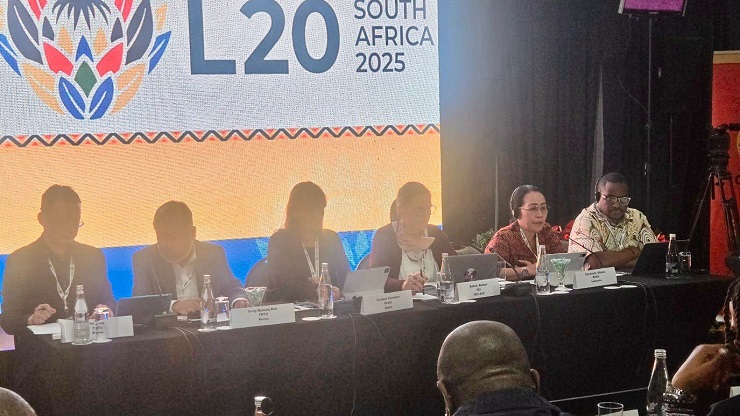
SOUTH AFRICA – KSBSI President, Elly Rosita Silaban, attended the Labour 20 (L20) Summit 2025, held at the Fancour Hotel and Conference Centre in George, South Africa, on July 27-28, 2025.
The L20 Summit 2025 took the theme “Fostering Solidarity, Equality, and Sustainability Through a New Social Contract.”
“The Labour 20 (L20) and Ministerial Meeting was attended by 97 representatives of trade unions from G20 countries affiliated with the ITUC and more than 100 representatives of G20 governments,” said Elly Rosita Silaban when contacted by phone on Monday (July 28, 2025) local time.
The event was opened by government representatives, Mayor George, representatives of L20 South Africa (Cosatu), representatives of Business 20, representatives of the Brazilian Federal government, representatives of the US government and the South African Minister of Manpower.
“After the coffee break, the session continued with remarks from the ITUC Secretary General, Luc Triangle, followed by representatives of South African trade unions,” explained Elly.
The L20’s priority statement to the G20 Ministers of Manpower for 2025 is as follows:
- Supporting decent work, addressing inequality, and reducing the labor share of income.
- Digitalization and an inclusive future of work.
- Just Transition.
- Gender equality and youth inclusion for an inclusive world of work.
On this occasion, the President of the KSBSI, Elly Risita Silaban, had the opportunity to be a resource person in the first panel discussion session. The KSBSI President spoke on “Green Industrial Policy and a Just Transition.”
Indonesia’s policy banning the export of raw minerals, particularly nickel and bauxite, presents both strengths and challenges in the employment context.
On the positive side, this policy has encouraged domestic downstream industrialization, in line with the constitutional mandate to utilize natural resources for the public good. Becoming a producer of processed materials, such as EV batteries/electric vehicles, positions Indonesia strategically in the global supply chain and supports the development of green industries.
“This policy has also encouraged investment, as seen in the development of smelters in both regions (Morowali and Teluk Weda), with the potential for job creation,” said Elly.
However, challenges remain. Local labor absorption is low, with many jobs going to non-local or foreign workers. Employment data transparency is lacking, and local communities often do not directly benefit.
Occupational safety and health (OSH) conditions also require urgent improvement, but these efforts are largely employer-led, with limited worker participation due to weak union representation.
Furthermore, Elly Rosita Silaban stated that local communities experience only minimal benefits. Infrastructure such as roads, schools, and healthcare services remain underdeveloped. The use of coal-fired power plants for smelters also contradicts climate goals.
To ensure sustainable and equitable progress, Indonesia must adopt a Just Transition approach—focusing on workers, upholding labor rights, encouraging the use of renewable energy, enabling inclusive social dialogue, and ensuring the benefits of industrialization reach local populations.
The KSBSI President also shared additional notes, including:
- The energy transition has created 4 million jobs by 2024, with a target of 15.3 million new jobs by 2045.
- The number of youth in the NEET (Not in Education and Employment or Training) category, or not in education, employment, or training, reached 22.25% in 2023.
- Without intervention, unemployment will increase in the next decade.
- Increase in precarious employment and contract workers in new industries.
- The transition is often driven by elites.
- There is a lack of connection between the green industry and the education or vocational system.
- A systemic approach is needed to align the interests of young workers with the requirements of the green industry. (RED/handi)