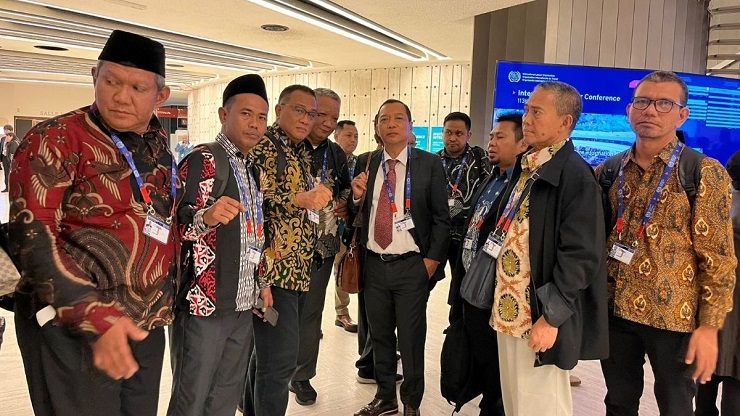
Geneva - The global labor movement, including the Indonesian labor movement, welcomed the vote that favored motorcycle taxi (ojek) workers' aspirations for clarity in their employment status.

Rekson Silaban, a member of the Advisory Board of the All-Indonesian Trade Union Confederation (MPO KSBSI), contributed to the convention debate in his capacity as head of the labor delegation on the Platform Committee.

In the future, digital platform workers will have employee status, or no longer partner status, as this has created several inequalities in legal protection.

The International Labor Conference (ILC)'s economic platform committee is still underway to formulate the types of protections for online workers, the format of working hours and the form of remuneration. It also addressed the need for uniform government-drafted employment agreements, oversight systems, and union regulations.

"At the committee meeting, I spoke on behalf of Indonesia. Ultimately, the KSBSI succeeded in passing a Convention for the Protection of Motorcycle Taxi Workers. The full contents of the Convention will be formulated at the 2026 ILC. The important thing is that employment status is clear: that is, workers." said Rekson Silaban via phone on Thursday (June 5, 2025) local time.

Rekson emphasized that with the Geneva agreement, there will be two types of online motorcycle taxi worker statuses: one, workers in an employment relationship (if they work standard hours), and the other, independent workers (if they work flexible hours). "KSBSI requests that the State Secretariat (which is currently preparing the Presidential Regulation on Platforms) include labor groups in the preparation of the Presidential Regulation," said Rekson.

Rekson Silaban also hopes that with the spirit of Geneva, which ensures that Platform Workers are workers, all countries can begin issuing regulations.

"If the Indonesian government wants to create regulations, such as a Government Regulation (PP) or Presidential Regulation (Perpres), in the spirit of this ILO Decision, it can, and that's good, without having to wait for the issuance of the ILO Convention," added Rekson.

As is known, Indah Anggoro Putri, Director General of Industrial Relations and Social Security at the Indonesian Ministry of Manpower, spoke on behalf of the Head of the Indonesian Delegation, Minister of Manpower Prof. Yassierli, and stated that Indonesia supports the issuance of the ILO (International Labor Organization) Convention for Digital Platform Workers. The Indonesian workers' struggle to secure the fate of platform workers, especially online drivers, including those who ride-hailing motorcycle taxis, feels united with the Indonesian government. This was evident during the vote to determine whether platform workers should be regulated in a Convention or simply a Recommendation. Eighty-six votes, including those from the Indonesian government, voted for the Convention, winning against 27 votes for the Recommendation alone.

What made the workers grateful was not only the need for the ILO to create a Convention, but also the genuine commitment of the Indonesian government, through the Ministry of Manpower, to work together with the Labor Delegation.

After it was decided that platform workers would be protected under the Convention, the next stage would be the drafting of the Convention, which would take place over the next year.

The Convention is expected to be ratified in 2026. After that, ILO member countries will be asked to ratify it or make it into law in their respective countries. (RED/Handi)