
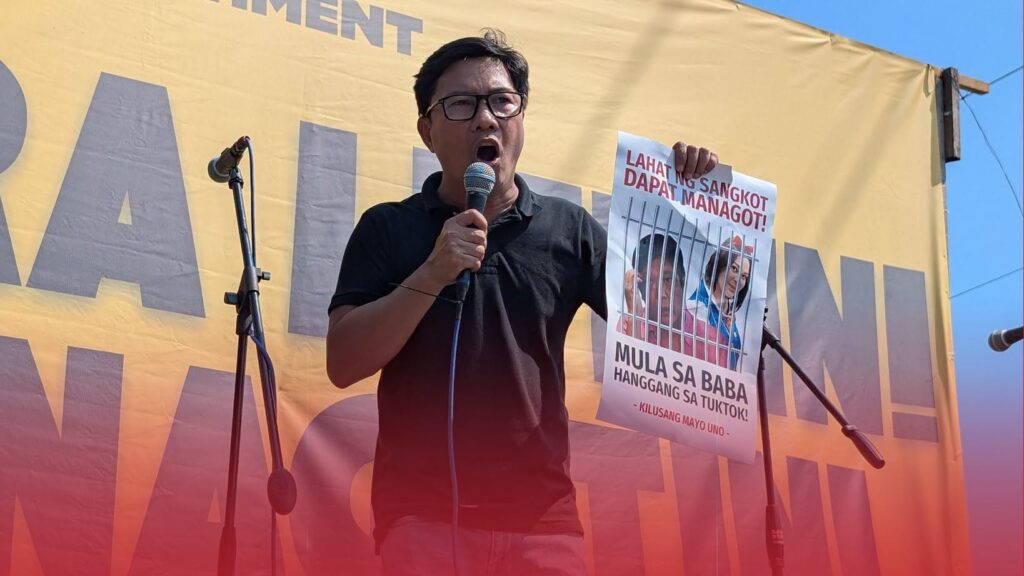
Jakarta – Saturday, August 15, 2026 – ACVi Asia expresses serious concern over the issuance of an arrest warrant for the Chairman of Kilusang Mayo Uno (KMU), Jerome Adonis, in connection with the 2026 May Day protests.
ACVi Asia urges the dismissal of all false charges against labor leaders and activists!
ACVi Asia will gather solidarity support from its partner union leaders in other Asian countries, particularly Indonesia, Cambodia, and Nepal, as well as ITUC AP affiliates in the region, as a form of solidarity with Jerome Adonis and his colleagues, as well as condemnation of the Philippine government for their arrests and false charges.
Furthermore, broader support will be garnered from the ACVi office in Belgium, as stated by Jeoren Roskams, to bring together other institutions such as WSM, ACV PULS, and other organizations to strengthen solidarity actions for the arrest of KMU leaders.
As is known, Kilusang Mayo Uno (KMU) Chairman Jerome Adonis was the target of an arrest attempt after a warrant was issued on trumped-up charges of violating Article 153 of the Revised Penal Code in connection with this year’s May Day protests. On this same day 44 years ago, under the Marcos Sr. dictatorship, former KMU Chairman Felixberto Olalia Sr. and twelve other union activists were also arrested in Manila.
Jerome Adonis is a prominent labor leader who not only represents the KMU but also plays a key role in the National Wage Coalition (NWC), an alliance of major labor centers pushing for wage increases, and the International Trade Union Confederation (ITUC), a confederation of the world’s largest labor centers. He is running for senator in the 2025 national elections under the Makabayan Coalition. He is also a staunch anti-imperialist leader and currently serves as the 2nd Deputy Secretary-General of the International League of People’s Struggle (ILPS).
The threat of arrest comes at a crucial time. Adonis led the recent wave of protests demanding a living wage after the Department of Labor and Employment (DOLE) issued a Temporary Suspension Order against the implementation of the Php 85 wage increase in Metro Manila.
Previously, he led the Filipino Workers’ Delegation to the International Labor Conference (ILC), where he advocated for a living wage, job security, and freedom of association.
Adonis was also vocal in his opposition to the Pax Silica initiative proposed by the Marcos Jr. regime. He asserted that the initiative threatened the lives and livelihoods of the Filipino people by enabling the theft of our land and resources and trampling on our national sovereignty. These stances were among the issues highlighted by Adonis and other KMU members during the recent May Day mobilization.
Instead of listening to the genuine concerns of Filipino workers, the government has filed trumped-up cases against Adonis, Kilusan ng Manggagawang Kababaihan (KMK) spokesperson Jacq Ruiz, and other leaders and activists.
The attacks on Adonis, Ruiz, and other labor leaders are a direct attack on the entire labor movement and the fundamental rights of the Filipino people.
Shoya Yoshida, Secretary General of ITUC-Asia Pacific. “The criminalization of dissent has no place in a democracy. Trade union activists must be free to organize, speak out, demonstrate, and hold the government accountable without fear of arbitrary arrest or prosecution for conducting legitimate and peaceful union activities.”
The arrest and prosecution of a trade union activist in connection with the May Day mobilization risks having a chilling effect on workers and union activists seeking to voice their opinions. The right to protest should be respected, not punished.
Standing in solidarity with Jerome Adonis, the KMU, and all workers exercising their fundamental rights, the ITUC-Asia Pacific calls on the Philippine authorities to immediately drop the charges against Brother Jerome and other trade union activists. Any allegations of unlawful conduct by individuals must be handled separately from their legitimate trade union activities, strictly in accordance with due process and based on independently verifiable evidence. The authorities must ensure that criminal laws are not used to intimidate trade union activists or suppress legitimate trade union activities and dissent. (red/handi)